
Interim Executive Cost Compared With Full-Time Salary and Benefits

A higher interim rate doesn’t automatically mean a higher total cost. The cost of InterimExecs vs. a full-time salary depends on the assignment: interim leaders are engaged on a fractional, interim, or project basis, while full-time employees receive salary and employment benefits.
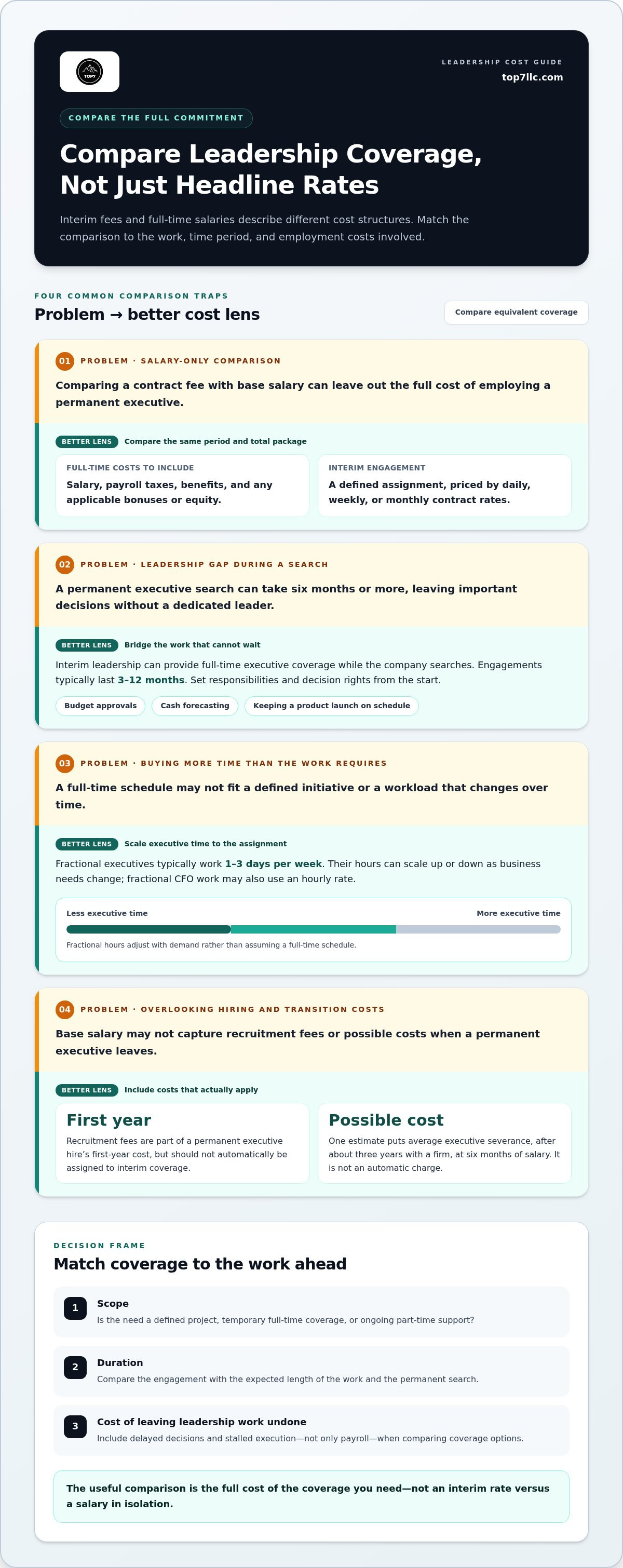
It’s easy to compare a contract fee with an annual salary and miss the real expense. A full-time role also involves payroll taxes and benefits, while bonuses, equity, and the length of the commitment can change the total. Compare the full cost of the coverage you need, not just two headline figures.
This article explains how interim executive fees compare with full-time compensation, what employment costs to include, and when temporary or fractional CFO support may fit better. Assignment scope and duration shape the decision, so match leadership coverage to the work ahead rather than committing to the wrong cost structure.
Table of Contents
How Much Does An Interim Executive Cost?
Interim executives are engaged for a defined assignment, while permanent hires carry salary and employment costs. Compare the full assignment with the full cost of a hire, not salary alone.
Interim and Permanent Executive Compensation
Interim compensation covers a defined assignment; permanent executive compensation can include salary, bonuses, benefits, and long-term incentives. In the U.S., interim leaders are not employees on the company’s payroll, while full-time interim leadership typically costs more than fractional support.
Engagement Pricing and Additional Fees
Interim executive engagements may use daily, weekly, or monthly contract rates; fractional CFO work may also use an hourly rate. The market facts don’t establish a single pricing model for a specific provider or whether a project fee applies. Recruitment fees are part of a permanent executive hire’s first-year cost, but shouldn’t be assumed to apply automatically to interim coverage.
There’s no single U.S. salary average that fits every comparable executive role. The trade-off is flexibility versus continuity: an interim executive brings focused leadership for a defined period, while a full-time employee offers ongoing commitment and may build deeper institutional knowledge.
Scaling Executive Hours to Business Needs
Fractional support matches executive time to the work, rather than buying a full-time schedule. Fractional executives typically work 1-3 days per week, and their hours can scale up or down as demand changes. That can suit a growth initiative or transition requiring sustained leadership without a permanent full-time commitment.
A vacancy has its own cost. When weighing interim coverage against waiting for a permanent hire, include delayed decisions and stalled execution in the comparison, not just payroll.
For example, a defined project may need concentrated executive attention, while a changing workload may call for fractional hours. If needs shift within 6 or 12 months, adjustable support can avoid locking the business into a permanent role before its long-term requirements are clear. The decision turns on scope, duration, and the cost of leaving leadership work undone.
Salary, payroll taxes, and benefits in the full-time cost estimate
A full-time executive’s cost extends beyond salary: payroll taxes and benefits add to the employer’s monthly commitment. A U.S.
Benefits and Equity Considerations
Benefits and equity can be part of a permanent executive compensation package, alongside salary and potential bonuses. A salary-only comparison leaves out costs and incentives tied to the full-time role. Interim engagements are typically structured differently from employee roles, so benefits may not be included in compensation. Compare the expected total package with the engagement cost for the same period.
It includes payroll taxes and benefits, but excludes bonus and equity. Those exclusions matter: if a permanent offer includes performance bonuses or long-term incentives, the full compensation package exceeds the stated monthly estimate. Set the comparison period first, then include each cost that applies during that engagement.
For example, a company comparing interim coverage with a permanent CFO should account for the employment costs over the same period, not simply divide base salary and ignore benefits. The decision also depends on how compensation is structured and how long the role is expected to last. A defined assignment and an ongoing employee commitment have different cost profiles.
Avoiding Benefits and Severance Overhead
Interim work avoids adding employee benefits to the executive’s compensation package, but it doesn’t eliminate every cost of leadership. This distinction matters when a company needs temporary coverage without a permanent employment commitment. Compare the engagement cost with payroll, benefits, and potential transition costs for a full-time hire.
Severance can change the full-time estimate. One estimate puts average executive severance, after about three years with a firm, at six months of salary. Treat this as a possible cost consideration, not an automatic charge: actual exposure depends on the employment arrangement.
The practical challenge is balancing near-term coverage against longer-term obligations. Interim leadership may avoid employee benefits and severance overhead, while a permanent role may make sense when the need is continuous. Compare the full-time package, expected duration, and likely transition costs with the interim assignment. This reveals the real commitment instead of letting base salary dictate the decision.
Temporary leadership during a permanent search
A permanent executive search can take six months or more, leaving critical decisions without a dedicated leader. Interim leadership provides full-time executive coverage for a defined period, keeping operations and priorities moving while the company searches.
Interim executive engagements typically last 3-12 months. That duration can bridge a vacancy, a transition, or a period when the role’s long-term scope is still taking shape. The assignment should have clear responsibilities and decision rights from the start. Otherwise, temporary coverage can preserve activity without resolving the leadership gap.
The search timeline can stretch beyond the initial plan. A full-time executive hire may take weeks to months or years to start, while a permanent search can take six months or more. Shape interim coverage around work that cannot wait, such as approving budgets, managing a cash forecast, or keeping a product launch on schedule. Keep hiring criteria separate from urgent operational tasks.
Interim work can also clarify what a permanent hire must deliver. Define priorities before the interim leader starts, then assess progress against them during the assignment. For example, a company hiring a CFO could track the quality of financial reporting, forecast reliability, and readiness for financing discussions. These observations can sharpen the permanent role’s requirements and help stakeholders assess candidates against real operating needs.
Interim leadership is already part of senior-level transitions. In the first half of 2025, 12 of the 61 new S&P 500 CFO appointments were interim CFOs. That example shows how temporary coverage can fill a defined leadership role, but it doesn’t remove the need to decide what happens after the assignment ends. Set a transition point early: extend temporary coverage, appoint the permanent leader, or revise the role’s scope.
A practical handover turns interim work into continuity. Document decisions, open risks, reporting routines, key relationships, and upcoming deadlines. For a CFO transition, the outgoing leader can walk the permanent hire through forecasts, cash priorities, and unresolved approvals. Build time for joint review into the assignment’s final phase. The incoming leader then inherits context, not just a folder of files.
Clear contract terms support that transition. Interim executive contracts can generally be terminated with 30 days’ notice, which can help align the engagement with a permanent leader’s start. Treat the notice period as a planning window, not a substitute for handover preparation. Define ownership of decisions and records before the temporary assignment begins, then transfer them deliberately.
Fractional CFO and other C-suite roles
A fractional executive provides part-time leadership through an ongoing engagement, rather than taking a permanent full-time role. This model can suit a business that needs senior financial or operational judgment, but not a full executive workload.
Fractional CFO support can focus on cash visibility, forecasting, financial controls, or preparation for a financing decision. Define priorities, decision rights, meeting cadence, and expected outputs at the outset. Without that structure, limited leadership capacity can disappear into routine requests instead of addressing the central business question.
The same logic applies across C-suite functions. A fractional COO can address operating friction; a fractional CTO can guide technology priorities; a fractional CEO can help set direction. Choose the role based on the decision the business needs to make or the capability it needs to build. A turnaround may call for sustained financial oversight, while a product launch may need focused executive input.
Fractional engagements typically last from six months to multiple years. That duration supports continuity without requiring a permanent full-time commitment. It can also suit a company whose needs may shift within 6 or 12 months. The right contract ties executive time to changing business demands, with room to scale support up or down.
Consider a company preparing to launch a product. The work may require a chief marketing officer for 18 months, rather than an indefinite appointment. A fractional leader can help shape the launch plan and oversee priorities across that period. The company can then reassess the role once the launch phase ends and ongoing responsibilities become clearer.
Immediate access is not the only test. Fractional executives can start within days, but the assignment still needs a defined mandate. Identify the decisions that require executive authority, the teams involved, and the outcomes expected. Then set a cadence that gives the leader enough context to act, without paying for unused capacity or creating confusion about accountability.
Fractional CFO costs vary with scope, expertise, time commitment, and engagement duration. Compare terms by the work delivered, not only by hours or a headline rate. A narrow advisory need differs from ongoing forecasting and decision support. That distinction helps separate targeted expertise from a full-time role’s broader responsibilities and continuing commitment.
Fractional support is not a substitute for every permanent executive. A company needing daily leadership across a broad function may require full-time coverage. But when the need is specific, evolving, or tied to a defined turnaround, a fractional role can align executive capacity with the work. Start with the business problem, then size the commitment to match it.
Interim CFO costs compared with a full-time CFO salary
For a U.S. CFO, compare full-time employment costs with the interim assignment’s scope and duration. A complete estimate gives organizations a fuller baseline than salary alone, but it won’t represent every compensation package or situation.
An interim CFO’s effective fee may exceed the cost of a permanent C-suite hire. That doesn’t settle the comparison. A permanent CFO fills an ongoing function, while an interim CFO provides executive coverage for a defined period. The relevant question is how much leadership the organization needs, and for how long.
Consider a vacancy during a cash-flow disruption. The interim assignment may focus on forecasting, lender communication, and decisions that cannot wait for a permanent hire. A permanent CFO may take responsibility for those priorities and the broader financial function over time. Compare the work delivered during the engagement, not simply the contract fee with an annual salary.
Scope changes the calculation. A defined turnaround may require intensive oversight, while a stable organization may need targeted financial decisions. Duration matters too: coverage for a transition differs from ongoing executive leadership. Set out the required decisions, deliverables, and authority before comparing options. This makes the comparison reflect operational needs instead of assumptions about job titles.
Flexibility is a key distinction. Interim coverage can be set around a temporary vacancy or defined business need; a full-time CFO represents an ongoing employment commitment. The full-time estimate may also exclude bonus and equity, so include those elements when they form part of the expected package. The strongest analysis weighs total coverage and compensation over the same period.
A permanent hire may be the better fit when the organization needs continuous leadership across finance, planning, and company-wide decisions. Interim coverage can suit a defined transition or urgent leadership gap. Neither model automatically wins on cost. The deciding factors are scope, duration, responsibilities, and the consequences of leaving the CFO function without executive ownership.
To make the decision, list the CFO responsibilities that must remain covered, separate urgent priorities from ongoing duties, and match each to the required leadership commitment. Then compare the employment package with the interim assignment for the same period. This exposes whether the vacancy requires temporary coverage or a lasting role. Plan your executive coverage around the work your organization needs done.
Top7: Fractional CTO
Top7’s Fractional CTO can help when your organization needs technology leadership without adding a permanent executive role. If the challenge is broader than technology, a Fractional CFO, Fractional COO, or Fractional CEO may better match the work ahead. The key is to define the decisions, priorities, and leadership responsibilities that need ownership, then align executive support with that scope. This makes the next step practical: address the leadership gap without confusing a targeted need with a full-time hire. Contact Top7 to discuss which executive role fits your organization’s priorities.
Make Your Next Leadership Move Deliberate
A clear view of the cost of InterimExecs vs. a full-time salary is useful only when it leads to a decision about the work your organization needs done. Identify the leadership gap, the outcomes that matter, and the level of ongoing ownership required. Then choose a structure that fits the business, not just the job title.
Top7 offers Fractional CTO, Fractional COO, and Fractional CEO support for organizations that need focused executive leadership. The right fit depends on where decisions are stalled and which function needs experienced direction. Start with the business challenge, then define the priorities an executive should own.
Explore executive support with Top7 and take the next step with a clearer leadership plan. Strong decisions start with a clear view of the work ahead.
Frequently Asked Questions
Is an interim CFO the same as a contract CFO?
The labels can describe similar temporary arrangements, but they don’t guarantee identical scope. An interim CFO usually signals executive responsibility during a defined transition or business need. “Contract CFO” emphasizes the contractual engagement and may cover narrower advisory work. For example, one assignment might require ownership of cash forecasts and board reporting, while another may focus on a specific finance project. Compare authority, deliverables, and expected involvement.
What Impacts Interim Leadership Costs?
Role scope, company size, required competencies, and assignment duration shape the cost. A CFO responsible for cash-crisis decisions and investor reporting has a different mandate from one focused on a single forecast. Urgency can matter too: an emergency interim CFO start within seven days carries a 15-25% premium. Define the decisions, deliverables, and time commitment before comparing proposals, so different scopes don’t distort the comparison.
When Should Companies Use Fractional Executives?
Use fractional leadership when the organization needs senior judgment but not a full-time executive workload. It can suit a company building a financial plan, improving sales oversight, or managing a technology roadmap while its needs evolve. Fractional executives typically work 1-3 days per week, with time scaled to business demand. A permanent role is a stronger fit when continuous, broad ownership is essential to daily operations.
What are typical InterimExecs rates by role and seniority in the United States?
There’s no industry-standard interim executive rate in the United States. Compensation depends on the role, assignment scope, company size, and required competencies, so seniority alone won’t determine the fee. CFO coverage involving financing decisions differs from a narrower reporting mandate. Compare the responsibilities, schedule, and engagement duration to make a useful role-to-role comparison without treating different assignments as equivalent.
What is the total cost of hiring an InterimExecs executive for 3, 6, or 12 months?
To assess the cost of InterimExecs vs full-time salary across 3, 6, or 12 months, calculate the agreed contract rate for the engagement period and include any costs specified in the agreement. The total changes with the rate structure, schedule, and assignment scope. A daily contract and a monthly engagement won’t calculate identically. Compare the same responsibilities and coverage period, and don’t assume a longer term automatically changes the rate.
What benefits, payroll taxes, bonuses, and equity add to the total cost of a full-time executive?
Costs beyond base salary depend on the employer’s compensation package. Build the estimate by adding employer payroll taxes, benefit premiums, expected bonus, and any equity incentives to salary for the same period. For example, separate recurring benefits from performance-based compensation. This prevents an interim engagement from being compared with only one part of a permanent executive’s total compensation.
How do InterimExecs costs compare with hiring a full-time executive or using another interim firm?
Evaluate the cost of InterimExecs vs full-time salary by comparing equivalent coverage, not a contract rate against salary alone. For a full-time hire, include the compensation package and recruitment costs; for interim options, compare the same scope, schedule, and engagement duration. With another firm, align the proposed executive responsibilities and deliverables before evaluating totals. Different terms can make headline figures misleading, even when both proposals use the same role title.
What factors affect InterimExecs rates, including role, location, industry, and engagement length?
Rates reflect the role’s responsibilities, the expertise required, company size, assignment scope, and duration. Industry can shape the competencies and operating context needed; location may also affect the available market for particular talent. Engagement length matters because a defined transition differs from ongoing fractional support. Compare proposals by clarifying the work, expected involvement, and decision authority, rather than relying on title or location alone.



Comments