
Interim COO for Operational Restructuring: Turn Disruption into Execution

What if the restructuring isn’t what’s slowing the business down, but the lack of one accountable operator? An interim COO for operational restructuring can take ownership of decisions and follow-through while the business keeps running. Without that ownership, critical processes stay unclear, a few people become the fallback for everything, and change initiatives compete with day-to-day work.
Restructuring can’t succeed if teams lose sight of business continuity. The answer isn’t another plan that sits on a shelf. It’s clear operational priorities, named owners, and a review cadence that makes progress visible.
This article explains when an interim COO can lead restructuring, what the work involves, and how to move from disruption to an accountable operating plan. You’ll see how an embedded leader can stabilize essential processes, prioritize capacity and change, and leave documented playbooks with accountable leaders ready to carry the work forward. We’ll also cover how Top7’s Velocity-7 Framework structures the climb from diagnosis to execution and handoff, with one point of contact for every engagement. The goal is practical: keep the business moving and build an operating model that doesn’t depend on one person holding everything together.
Table of Contents
When Operational Restructuring Needs an Interim COO
Start by identifying the problem: are you filling a leadership vacancy, correcting an operating-model issue, or addressing both? A vacant COO seat leaves a gap in ownership. A flawed operating model creates friction even when every leadership role is filled. If both are true, the business needs someone who can keep decisions moving while addressing the underlying structure. An interim COO for operational restructuring provides a clear operational lead during a temporary leadership need.
Restructuring goes beyond improving one slow process. It can change who owns decisions, how capacity is allocated, how work moves between teams, and which priorities take precedence. That scope fits the broader idea of corporate and operational restructuring, which includes organizational changes intended to improve how a business operates. The point isn’t to label every problem a crisis. It’s to recognize when unresolved friction threatens continuity and execution.
For a concise overview of operational restructuring, watch this video:
Signs the operating model, not just one process, needs to change
Look for patterns across teams, not isolated mistakes. A handoff fails repeatedly because no one owns the next step. Two departments recreate the same information. A decision waits for one overloaded manager while work piles up behind the bottleneck. These symptoms point to an operating-model problem when they recur across core workflows or prevent teams from acting on shared priorities.
Capacity planning helps reveal whether the work, people, and priorities still fit together. For example, a growth push may add operational demands while responsibilities and decision rights stay the same, leaving teams stretched in conflicting directions. That’s different from one employee missing a target or one workflow needing a local adjustment. Restructuring becomes relevant when the mismatch is built into how work is assigned and coordinated.
What an interim COO brings to a restructuring
An interim COO provides accountable operational leadership across organizational design, process ownership, and execution. The role is to clarify who decides, who acts, and how leaders track whether changes are taking hold. That means weighing proposed changes against business continuity, sequencing work so teams can meet day-to-day needs, and resolving ownership gaps rather than passing them along.
That’s the difference between embedded leadership and advice alone. A recommendation can describe what should change, but implementation still needs someone to drive decisions, coordinate owners, and follow through when priorities collide. An interim COO takes responsibility for that operating work during a defined leadership need. The engagement is temporary, with the aim of strengthening execution and establishing clearer ownership. Use the role when the business needs both steady day-to-day control and a leader accountable for changing the system.
How an Interim COO Moves Restructuring from Diagnosis to Execution
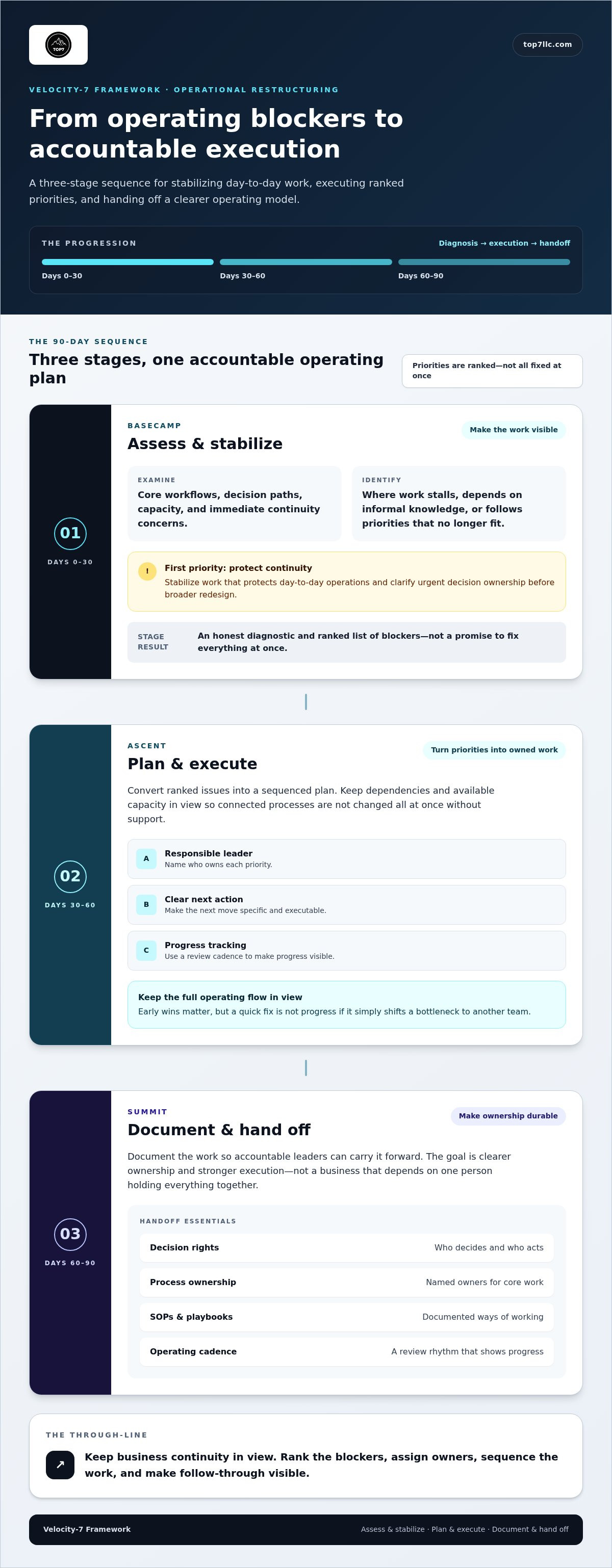
A diagnosis only matters if it changes what happens next. The Velocity-7 Framework gives restructuring a clear sequence: assess operating conditions, turn findings into owned priorities, then document the work for a sustainable handoff. This helps leaders focus on execution instead of launching disconnected initiatives that compete for the same people and attention.
A restructuring diagnostic is a ranked view of operating blockers and ownership gaps, not a promise that every issue can be fixed at once. Ranking matters. A continuity risk may need immediate action, while a process redesign can wait until the right owner and capacity are in place. The U.S. Bureau of Labor Statistics overview of executive responsibilities provides useful context for the leadership accountability behind this work.
Days 0-30 (Basecamp): Assess & Stabilize
Begin with the facts on the ground. Review core workflows, decision paths, capacity, and immediate continuity concerns. Where does work stall? Which processes depend on informal knowledge? Are teams spending time on priorities that no longer match operating demands? The goal is an honest diagnostic and ranked list of blockers, not a polished report that hides trade-offs.
Ranking gives leaders a practical first move. Stabilize the work that protects day-to-day operations, clarify urgent decision ownership, and distinguish those needs from broader redesign. For example, a recurring approval delay might call for an immediate decision owner, while a cross-team workflow issue may require deeper process changes. The diagnostic creates focus; it doesn’t guarantee a particular result.
Days 30-60 (Ascent): Plan & Execute
Next, convert the ranked issues into a sequenced plan. Each priority needs a responsible leader, a clear next action, and a way to track progress. Sequence work according to dependencies and available capacity so teams aren’t asked to change several connected processes at once without support.
This stage includes early wins, but speed alone isn’t the target. A quick fix that shifts a bottleneck to another team isn’t progress. An interim COO for operational restructuring keeps attention on the full operating flow, resolves ownership questions, and connects actions to measurable priorities. The result is a plan people can execute, with an accountable leader driving follow-through.
Days 60-90 (Summit): Systematize & Hand Off
Then make the improved way of working repeatable. Document playbooks and key processes, establish clear ownership, and equip the team to manage the operating cadence without relying on one person’s memory. The aim is a self-sustaining team, not a permanent queue of decisions for the interim leader.
The handoff also includes a clear hire decision: determine whether the business needs ongoing leadership in the seat or can sustain the operating model with existing leaders. That decision is an outcome of the work, not a promise of permanent placement. Top7’s 100-Day Operational Plan connects the diagnostic, execution priorities, and handoff. Explore COO leadership for restructuring execution as one way to put that sequence into practice.
Interim, Fractional, or Project: Choose the Right COO Model for Restructuring
The right model depends on the gap you need to close. Is the COO seat open and do operational decisions need a clear leader? Do you need ongoing, part-time executive ownership? Or is the mandate a defined piece of restructuring work with a specific deliverable? Top7’s Three ways to engage (Fractional, Interim, Project) match the form of leadership to the work, so you don’t confuse a vacancy with a scoped project or ongoing need.
When Interim leadership fits a restructuring mandate
Choose Interim when the COO seat is open or the business needs a leader accountable for operational decisions and execution. The interim COO embeds in the organization and leads from the seat, coordinating work across owners rather than leaving implementation to already stretched managers. The engagement is temporary, but its outputs can last: documented processes, clear ownership, and a deliberate handoff help the organization retain what the restructuring establishes.
When Fractional or Project engagement may fit better
Fractional fits when the company needs ongoing, part-time COO leadership alongside its existing team, rather than full-time coverage of an open seat. Project fits when the challenge has a defined scope, deliverable, and end date. For example, a specific operating-model redesign may suit project work, while continuing executive oversight across priorities may call for fractional leadership. Match the model to the actual gap.
Temporary doesn’t have to mean temporary results. Durable systems come from assigning process owners, documenting how work gets done, and making the handoff an explicit part of the mandate. The interim leader’s value isn’t simply holding the seat; it’s leaving the organization with stronger operating discipline and a clear next step. For restructuring that needs embedded ownership, Top7 COO leadership options align the engagement model with the operating need.
What an Operational Restructuring Plan Must Put in Place
A restructuring plan isn’t complete when the org chart changes or a new workflow is announced. It must make daily work easier to direct, measure, and sustain. Start with five connected decisions: who has authority, how roles are designed, where capacity goes, who owns each process, and how leaders review execution. An interim COO for operational restructuring can help turn those decisions into an operating system rather than a temporary push.
Restructuring is incomplete until new ownership and processes are documented. If people still rely on memory, private messages, or workarounds to get essential work done, the change hasn’t fully taken hold.
Reset roles, workflows, and operational technology
Organizational design and capacity planning belong together. Clarifying reporting lines without checking whether teams have enough capacity to meet their responsibilities creates a neat chart and the same bottlenecks. Start by connecting business priorities to the work required, then clarify which roles own decisions, delivery, and handoffs.
Map important workflows from request to completion. At each handoff, identify the sending and receiving owner, the information needed, and the decision that could hold work up. This makes duplicated effort and unclear responsibility visible. Review the operations technology stack at the same time: when systems don’t support coordinated execution, teams may have to re-enter information or rely on separate records. Integration work should address a specific workflow problem, not add technology for its own sake.
Make the change durable with an accountable handoff
Document how work should happen. Useful SOPs explain who does what, what information passes between steps, and how exceptions reach a decision-maker. Keep them practical and tied to real workflows. This gives teams a shared reference, reduces dependence on informal knowledge, and makes repeated workarounds easier to spot.
Then connect priorities to a KPI/OKR system. For each priority, name an accountable owner, define how progress will be assessed, and set a review rhythm. Leaders can use those review points to surface blocked work, resolve competing demands, and adjust capacity before missed handoffs become routine. Choose measures that help leaders act, not dashboards that merely record activity.
Decision rights: Make clear who can approve, redirect, or escalate work.
Process ownership: Name the leader accountable for each core workflow and its handoffs.
Capacity: Align available people and effort with operating priorities.
Operating cadence: Set regular reviews for progress, blockers, and decisions.
Documentation: Maintain usable SOPs and playbooks so the process doesn’t depend on one person’s memory.
Top7’s 100-Day Operational Plan is a named operations deliverable that connects restructuring work to accountable execution. The plan should support a real handoff: leaders know what they own, teams can follow documented processes, and operating reviews keep priorities visible. Build an accountable operational restructuring plan with Top7, with one point of contact for each engagement.
How Top7 Supports an Operational Restructuring
You’ve identified the operating problem, matched it to a leadership model, and defined the systems the business needs to keep. The next test is coordination: can someone connect operational decisions to execution across the work? Top7 provides COO leadership through Three ways to engage (Fractional, Interim, Project), aligning the engagement with the leadership gap and restructuring mandate. Every engagement has one primary point of contact, giving you a clear route for decisions and follow-through.
One point of contact, one framework, coordinated execution
One accountable contact helps keep the work connected, while the broader Top7 portfolio supports coordination across leadership needs. The COO’s operational remit can include organizational design and capacity planning, operations technology integration, post-close integration and cleanup, change management, SOP documentation, and KPI/OKR implementation. That matters when restructuring choices cross functional lines: teams need coordinated execution, not disconnected workstreams.
Top7 uses the Velocity-7 Framework to organize the engagement around Three stages (Basecamp, Ascent, Summit):
Days 0-30 (Basecamp): Assess & Stabilize through an honest diagnostic and ranked blockers.
Days 30-60 (Ascent): Plan & Execute with a sequenced plan, early wins, and an accountable leader.
Days 60-90 (Summit): Systematize & Hand Off with documented playbooks, a self-sustaining team, and a clear hire decision.
The stages create a shared structure for assessing the work, directing execution, and preparing the handoff. They don’t guarantee a financial or operational result. Their value is disciplined visibility: leaders can see what stage the work is in, who owns key actions, and what needs attention next. Top7’s 100-Day Operational Plan is the named deliverable for operational leadership, connecting restructuring priorities to accountable work.
Start the conversation with the operational challenge
Bring the real operating issue into focus. What leadership gap needs coverage? Where does work stall or lose ownership? Which decisions must change to protect continuity and move the restructuring forward? Clear answers help define whether interim COO leadership, ongoing fractional support, or a scoped project best fits the need.
If you need an interim COO for operational restructuring, start with the challenge and the decisions it demands. The initial consultation is 15 minutes, no pitch deck. Use that time to outline the leadership gap, operating friction, and priorities that need an accountable owner. Talk with Top7 about putting the right COO engagement behind the work.
Make the Next Operating Model the One Your Team Can Run
Restructuring creates lasting value when the business can keep making clear decisions after the immediate push is over. That takes more than a new org chart or a list of initiatives. It takes leaders who own the work and a team equipped to carry it forward.
If your company is weighing an interim COO for operational restructuring, focus the next conversation on what must change in daily operations and who will lead that change. Top7 brings one point of contact backed by its broader portfolio, a shared Velocity-7 Framework, and the named 100-Day Operational Plan to connect leadership with execution. The goal is a handoff your organization can act on, not activity for its own sake.
Bring the operating challenge, the leadership gap, and the decisions that can’t wait. Talk with Top7 for 15 minutes, no pitch deck. A clear first conversation can help turn uncertainty into the next practical move. Your team can make the climb with direction, ownership, and a stronger operating foundation.
Frequently Asked Questions
Is an interim COO only for a company in crisis?
No. An interim COO can help when a company needs operational leadership during a vacancy, a growth phase, an acquisition integration, or a change in how teams work. The useful trigger isn’t a crisis label; it’s a gap between what the business needs to execute and the ownership or capacity available to do it. If decisions are stalling or priorities are colliding, address the operating risk before it escalates.
Can an interim COO restructure operations without replacing the existing team?
Yes. Restructuring can change responsibilities, decision paths, or workflows without replacing the people doing the work. An interim COO can assess where the operating model creates friction, involve the leaders closest to the processes, and clarify who owns each outcome. For example, a recurring delay between sales and delivery may call for a clear handoff and escalation path, not a personnel change. Team decisions remain specific to the organization’s needs.
What should a CEO prepare before an interim COO begins?
Prepare a concise view of the business’s priorities, current leadership structure, major workflows, and decisions that routinely stall. Bring existing operating reviews, performance measures, and examples of recurring handoff problems, even if the information is incomplete. Also identify which decisions the interim COO can make independently and which require CEO or board approval. Clarifying access and authority helps the leader distinguish urgent operating constraints from assumptions that need testing.
Who makes decisions during an interim COO engagement?
The company’s governance remains in place. The CEO, board, or other authorized leaders retain decisions that belong to them, while the interim COO leads operational decisions within the authority assigned to the role. Set those boundaries early: define approval thresholds, escalation routes, and who resolves conflicts between functions. For example, a COO may coordinate a workflow change, while a change to company-wide priorities still requires CEO alignment.
Can operational restructuring happen while the business continues operating?
Yes. Restructuring can be sequenced around essential work rather than treated as a pause in normal operations. Leaders can protect critical workflows, introduce changes in manageable steps, and monitor for unintended disruption as teams adapt. For instance, a handoff process can be clarified and tested with the people who use it before it becomes the standard. The operating plan should make clear what changes now, what waits, and who watches continuity.
What happens to the operating plan after the interim COO leaves?
The plan should remain usable by the leaders who inherit the work. That means assigning ongoing owners, keeping process instructions accessible, and making review responsibilities part of the team’s normal management rhythm. A practical test is whether a manager can explain the next action, the decision owner, and how progress is reviewed without relying on the interim COO. If not, the handoff needs more work before the engagement ends.
How is an interim COO engagement different from a restructuring project?
An interim COO engagement provides full-time, defined-term leadership when a COO seat opens unexpectedly. The leader operates in that seat and is accountable for operational direction within assigned authority. A project engagement instead focuses on scoped, time-boxed work with a clear deliverable and end date; it doesn’t inherently provide coverage for an open COO seat. Choose based on the gap: leadership ownership or a specific piece of work. The interim COO for operational restructuring leads through the operating mandate.



Comments