
How to scale a professional services firm with reusable IP

Customization isn’t the enemy of scale; rebuilding the work from scratch for every client is. To scale a professional services firm, standardize repeatable delivery, capture lessons from each engagement, and reserve tailored work for decisions that create real client value. Keep the expertise personal and the process reusable.
Clients don’t want a cookie-cutter answer. But bespoke work without clear boundaries can turn every project into a fresh operational burden, making growth depend on the same few people. The answer isn’t to strip out judgment. It’s to build a delivery system that helps more of your team apply that judgment consistently.
This article shows you how to turn experience into reusable intellectual property, set practical standards without flattening client needs, and build leadership structures that keep decisions moving. You’ll see how to test repeatable services, use playbooks and templates, and make customization deliberate rather than automatic. The goal is a firm that grows without sacrificing the quality clients value.
Table of Contents
1. What gets in the way of professional services firms’ scalability?
Scaling a professional services firm starts with a hard constraint: growth depends on people, trust, and repeatable delivery. If every client needs the same senior expert and every engagement starts from zero, more work stretches relationships and capacity instead of building momentum. Scaling means expanding your team’s ability to deliver value without making client interactions impersonal.
U.S. legal, tax, and regulatory requirements can affect how a firm hires, contracts, handles client information, and delivers regulated professional work. Requirements depend on the profession, business structure, workforce, and states where the firm operates, so include them in operational planning before expanding.
For a practical look at common scaling mistakes, watch this video from Consulting Success:
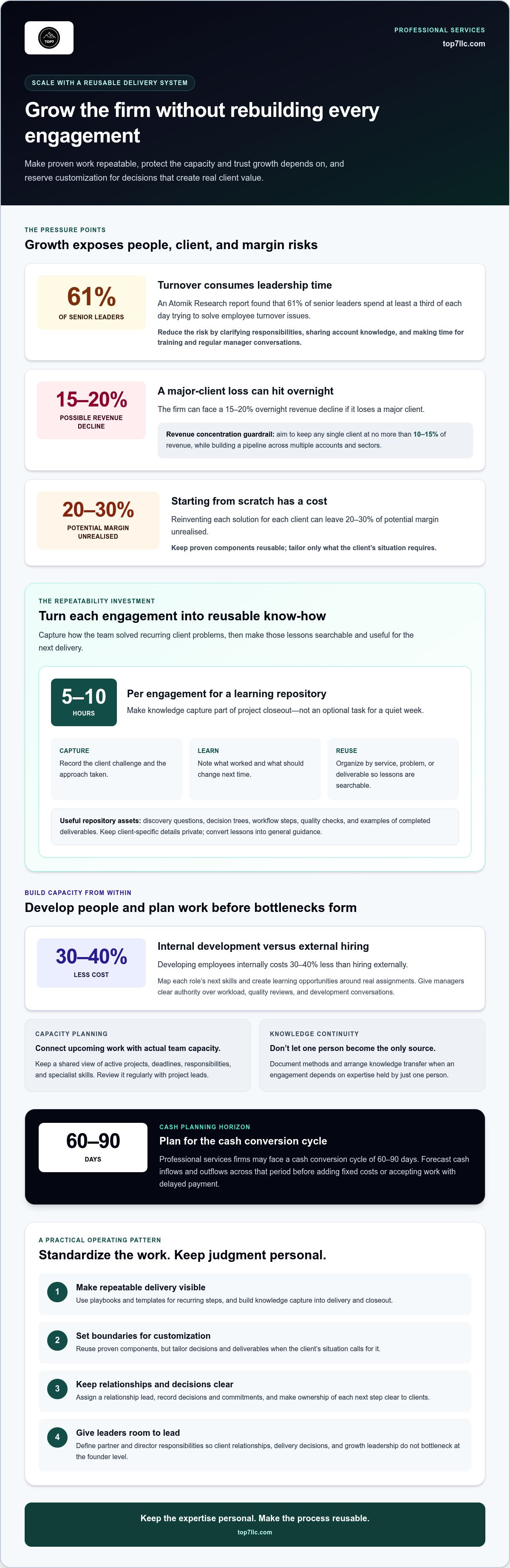
Employee relationships are part of the operating model, not a side issue. An Atomik Research report found that 61% of senior leaders spend at least a third of each day trying to solve employee turnover issues. When experienced staff leave, firms lose client context and delivery knowledge along with capacity. Reduce that risk by clarifying responsibilities, sharing account knowledge, and making time for training and regular manager conversations.
Client relationships face another pressure as teams grow: inconsistent service. Assign a clear relationship lead, record decisions and commitments, and tell clients who owns each next step. Ask for feedback after key project milestones, then use recurring comments to improve delivery. A client portal can make project status, documents, actions, and timelines visible in one place. Pair it with scheduled human check-ins. Software should support trust, not replace it.
Revenue concentration creates another scaling vulnerability. A firm can face a 15-20% overnight revenue decline if it loses a major client. Aim to keep any single client at no more than 10-15% of revenue, and build a pipeline across multiple accounts and sectors. Diversification is operational protection, not merely a sales target.
Bundling complementary services can deepen client value and improve efficiency: selling two professional services together costs less than selling them separately. Design the combined solution around a shared client outcome, with one accountable lead and clearly defined deliverables. Don’t bundle unrelated work just to inflate scope. Reinventing each solution for each client can leave 20-30% of potential margin unrealised, so keep proven components reusable and tailor only what the client’s situation requires.
2. Knowledge management and reusable intellectual property
To hire, train, and retain staff effectively, define the capabilities your delivery model needs, then build those skills deliberately. Document the work, pair new team members with experienced colleagues, and give managers responsibility for coaching and career development.
Reusable intellectual property starts with capturing how your firm solves recurring client problems. Create an engagement repository of practical assets: discovery questions, decision trees, workflow steps, quality checks, and examples of completed deliverables. Keep client-specific details private; turn lessons into general guidance the team can apply elsewhere.
Make knowledge capture part of project closeout, not an optional task for a quiet week. Creating an engagement learning repository takes 5-10 hours per engagement. Assign an owner, record the client challenge and approach, then note what worked and what should change. A searchable structure by service, problem, or deliverable makes those lessons easier to reuse.
New systems fail when people hear about them only after decisions are made. For each change, explain what is changing, why it matters, and how daily work will differ. Train the team with a live walkthrough and a real project example. Give people a way to flag friction, then revise the materials as the process evolves. Training and continuous learning help employees build capability as the firm grows.
Resource planning should connect the skills upcoming work requires with actual team capacity. Maintain a shared view of active projects, deadlines, responsibilities, and specialist skills. Review it regularly with project leads. If an engagement depends on expertise held by just one person, document the method and arrange knowledge transfer before that person becomes a bottleneck.
Middle managers turn that resource plan into consistent execution. Promote people who can coach others, coordinate work, and make sound delivery decisions, not only those with the strongest individual output. Give each manager clear authority over team workload, quality reviews, and development conversations. Developing employees internally costs 30-40% less than hiring externally, so map each role’s next skills and create learning opportunities around real assignments.
Start with one recurring engagement and improve its materials after each delivery. Strategic planning can connect those operating choices to the firm’s growth priorities. Build a system people will use, and make knowledge sharing part of the work.
3. How does a firm determine how to standardize professional service delivery?
Working capital needs depend on payroll, operating expenses, client payment timing, and growth commitments. Professional services firms may face a cash conversion cycle of 60-90 days, so forecast cash inflows and outflows across that period before adding fixed costs or accepting work with delayed payment.
Start with project profitability reporting. For each engagement, compare revenue with delivery costs, including staff time, subcontractors, and project-specific expenses. Apply one consistent method for assigning costs, then review results at project close and during longer engagements. A project can generate revenue yet weaken overall profitability if it absorbs too much senior capacity.
Pair project margins with resource utilization reports. Track planned and actual hours by role, project, and internal activity. These reports reveal bottlenecks, overloaded specialists, and unassigned capacity before they disrupt delivery. A software dashboard can bring the measures together, but define each metric consistently.
Utilization is a planning lever, not a target to maximize blindly. A 70-75% utilization target leaves room for business development, training, and systems work. Founders who track all work may discover actual utilization is 55-60%. Compare that baseline with role-specific targets: 50-60% for partners, 60-70% for senior staff, and 75-80% for junior staff. Use gaps to adjust project assignments and future hiring plans.
Build growth forecasts around delivery capacity and margin, not sales optimism alone. Estimate the people and skills each planned engagement requires, then compare demand with available capacity. Track revenue, profit margins, and overhead costs together. If new work increases revenue but adds disproportionate overhead, revise the delivery model before scaling that service.
Pricing pressure makes these reports more valuable. In a Q4 2024 Source survey, 58% of clients expected professional service prices to fall, compared with 27% in Q3. Use project data to identify which deliverables clients value, where scope expands, and which customization requires extra work. Protect profitability with clear boundaries, defined deliverables, and a documented process for approving scope changes.
Compensation should reinforce the behaviors the firm needs. Set clear performance measures for project quality, team development, and profitable growth, rather than rewarding utilization alone. A bonus pool can equal 50% of annual cash flow available for bonuses and equity distributions. Professional services directors and senior managers may receive upside worth 20% to 40% of base salary in a good year. Link incentives to sustainable results, and review them alongside project margins and capacity data.
Use combined reporting to decide what to standardize. Repeatable work with reliable margins and manageable resource demands is a strong candidate. Test the service, review project results, and refine its scope before expanding delivery.
4. Standardizing service delivery with playbooks and templates
Professional services firms can grow revenue without reducing service quality by standardizing repeatable work and protecting expert attention for client-specific decisions. A playbook makes proven delivery steps visible; templates reduce avoidable variation. The result isn’t identical advice for every client, but a reliable process for reaching a tailored answer.
Start with one recurring service and map delivery from kickoff to final review. Record client inputs, milestones, responsible roles, approval points, and quality checks. Turn common deliverables into templates, then test the package as a minimum viable service before expanding it across the firm. A controlled pilot exposes missing steps while changes are still manageable.
Make the process measurable. Track time, project costs, deadlines, scope changes, and review outcomes in a shared project view. Cloud-based tools can give distributed teams real-time access to schedules, resources, and project data. Assign one owner to update delivery status so project leads can spot delays and cost overruns before they threaten the final deliverable.
Repeatability should improve economics as volume grows. A service is scalable when delivery costs decrease as more people benefit from it. Digital, repeatable services can support that model, especially when one expert-developed resource serves multiple clients without requiring the same effort each time. Documented processes also improve accountability; companies that document their processes see 20% cost reductions.
Build quality and risk controls into the playbook, not someone’s memory. Set review gates for client inputs, analysis, recommendations, and final delivery. For example, require peer review before sending a strategy report, and record who approved material changes. Define customization boundaries, explain what falls outside the standard scope, and charge for additional work. This protects delivery quality and project margins.
Automation can handle routine tasks such as billing, revenue tracking, and customer success management, freeing the team for higher-value work. But automate a stable process, not confusion. Map handoffs and exceptions first, test changes on one service, and keep a person accountable for errors.
Review delivery data after each pilot. Compare planned and actual time, cost, client feedback, and quality issues, then revise the workflow. Keep steps that improve consistency, remove those that add no value, and invest in tools only when they eliminate a real bottleneck. Standardize the engine; keep expert judgment close to the client.
5. Partner and director leadership structures
Growth stalls when every important decision still waits for the founder. Define who owns client relationships, delivery quality, hiring, and business development before adding leadership titles. Give each partner a clear business contribution, while directors translate firm priorities into team-level execution. Document decision rights, escalation paths, and the results each role must deliver.
Ownership should reward both founding risk and later-stage growth. Founder partners commonly own 20% to 30% of the firm. Growth partners promoted later commonly own 3% to 8%. These are distinct positions, not automatic entitlements. Set expectations for each role, including the accounts, people, or capabilities they must develop.
Director incentives can connect daily leadership to firm performance. Director profit-sharing is often set at 2% to 5% of firm profits, with a path to full partnership after 3-5 years. Define the measures behind advancement, such as profitable delivery, employee development, client retention, and contribution to strategic priorities. Review progress consistently, and make the promotion criteria visible before decisions arise.
How should a firm choose between organic growth, acquisitions, and partnerships? Choose organic growth when existing talent, processes, and client relationships can reach the goal. Consider an acquisition when it fills a defined capability or market gap the firm can integrate. Use a partnership when complementary expertise or access advances the goal without requiring full ownership.
Each route needs an accountable sponsor and a practical review process. For an acquisition, assign leaders to assess integration, client continuity, team responsibilities, and delivery standards. For a strategic partnership, document shared objectives, ownership of client communication, decision authority, and how performance will be reviewed. If these basics remain vague, the deal can add complexity without advancing the goal.
Industry relationships can strengthen a firm’s reach and learning. Build a deliberate network through digital platforms, industry associations, and engagement with thought leaders and influencers. Give a partner or director responsibility for turning connections into useful conversations, referrals, or insight. Track follow-through in a shared relationship plan instead of treating event attendance as the outcome.
Review the leadership structure as the firm changes. If founders still approve routine delivery decisions, delegate authority and coach the next decision-makers. If directors lack ownership, clarify their mandate and measures. Use leadership accountability support to align roles, growth priorities, and execution before the next expansion push.
Top7: Fractional CTO
Top7’s Fractional CTO can help align technology decisions with your firm’s delivery model and growth priorities. Turn to this support when disconnected tools, unclear technology ownership, or manual workflows are slowing execution. The focus is not technology for its own sake. It’s choosing priorities that support consistent service delivery, useful management information, and better-informed decisions.
Bring a clear operating challenge to the work: for example, project teams can’t see current delivery status, or leaders lack a shared view of key information. A Fractional CTO can help assess the issue and guide technology priorities alongside the firm’s broader strategy. If the challenge centers on operations, overall leadership, or finances, Top7 also offers Fractional COO, Fractional CEO, and Fractional CFO support.
To discuss your firm’s technology and scaling priorities, contact Top7.
Make your next growth move deliberate
Growth becomes manageable when you stop treating every new opportunity as an exception. Choose one constraint limiting progress, assign an owner, and make the next decision based on what the business needs to deliver consistently. A focused move beats a larger plan nobody has time to execute.
A practical answer to how to scale a professional services firm is to match leadership capacity to the next stage of work. If technology decisions, day-to-day operations, or overall direction are consuming too much founder attention, additional senior leadership can help bring sharper ownership to those priorities.
Top7 offers Fractional CTO, Fractional COO, and Fractional CEO support for firms working through those leadership demands. Contact Top7 to discuss your growth and identify the leadership focus that fits your next move.
Build deliberately, keep learning, and make growth a system your team can sustain.
Frequently Asked Questions
How can firms balance customization with standardized service delivery?
Standardize the route to the result, then tailor decisions to each client’s context. For example, a consulting team can use the same kickoff agenda and analysis structure while adapting recommendations to the client’s business model. During intake, label each request as standard, optional, or custom. This makes scope visible early, helps teams estimate work consistently, and prevents unplanned customization from quietly changing delivery expectations.
How does a firm determine how to standardize professional service delivery?
Choose work that recurs across clients and has a clear, assessable outcome. Compare recent engagements to find common inputs, decisions, review points, and deliverables. Draft a workflow and test it on one service with a delivery team. Ask practitioners where steps fail or create unnecessary effort. Keep requirements that protect quality, revise those that cause friction, and expand the standard only after the pilot produces useful feedback.
What gets in the way of professional services firms’ scalability?
Growth gets stuck when rising demand creates more coordination than the firm can absorb. For example, a partner may remain the only person able to scope work, approve decisions, and reassure key clients. That creates a queue even when other employees have capacity. Map decisions that depend on one individual, then assign clear owners and escalation routes. This reveals whether the constraint is leadership, capability, or how work moves between teams.
What role does automation play in standardizing professional services?
Automation handles predictable administrative steps so people can focus on judgment, client discussions, and exceptions. For example, a workflow can route a completed intake form to the project lead and create a review task. Start with a stable process, define who monitors failures, and test unusual cases before wider use. Automation should make responsibilities and status easier to see, not hide weak processes behind another software layer.
Why and how does a service business scale?
A service business scales when it serves more clients or delivers greater value without adding effort at the same rate. Reusable methods separate expert insight from repeated administration. For example, a firm can turn a recurring diagnostic into a structured engagement with consistent inputs and decision points. The team still interprets each client’s situation without rebuilding the entire approach each time. Scale is useful when it improves capacity and economics without weakening outcomes.
What are the key steps to scale a professional services firm?
Set a specific growth objective, identify the main delivery bottleneck, and choose one service to improve first. Map its workflow, clarify ownership, and test changes with real client work. Track whether delivery quality, capacity, and profitability move in the right direction. Then document the improved approach and train the team before applying it elsewhere. This prevents expansion from multiplying unresolved problems across the firm.
What utilization and billable-hour targets should professional services firms aim for?
A broad utilization target is 70-75%, leaving time for business development, training, and systems work. Targets should differ by role: 50-60% for partners, 60-70% for senior staff, and 75-80% for junior staff. Review billable hours alongside workload, project results, and nonbillable responsibilities. If a skilled partner spends too much time on routine delivery, the answer may be delegation or process redesign, not a higher utilization target.
How should a professional services firm price its services as it scales?
Choose pricing based on how clearly the firm can define scope, delivery effort, and client outcomes. Pricing models can affect margins, but outcomes vary with scope, delivery costs, and client needs. These are model-associated margin ranges, not guaranteed results. Compare actual project costs and scope changes with revenue, then select the model the team can explain and deliver consistently.



Comments