
Consultant for Rebuilding an Underperforming Sales Team

A consultant for rebuilding an underperforming sales team should diagnose people, process, pipeline, and management before recommending changes. Consider a rebuild when more than 50% of the team fails to reach 80% of quota for two consecutive quarters. The cause may be the system around the reps, not just the reps themselves.
You may already have tried new tools, extra training, or a tougher quota. If results remain unpredictable, repeating the same fixes will not solve the underlying problem. First identify where performance breaks down, then rebuild the parts of the sales operation holding the team back.
This article explains what drives sales performance and how a consultant assesses calls, talent, processes, and management before shaping a turnaround. You’ll see how process redesign, qualification, coaching, and training work together, what to measure, and how restructuring can affect conversion, deal size, sales-cycle length, and revenue attainment. The aim is a practical view of what needs to change and why.
Table of Contents
Sequencing process redesign, qualification, coaching, and training
A sales turnaround consultant can assess calls, pipeline stages, qualification, and manager routines, then translate the findings into a clear sales process, practical coaching, and measurable operating changes. Look for leadership that can turn diagnosis into execution, not just recommendations.
Sequencing the Turnaround Work
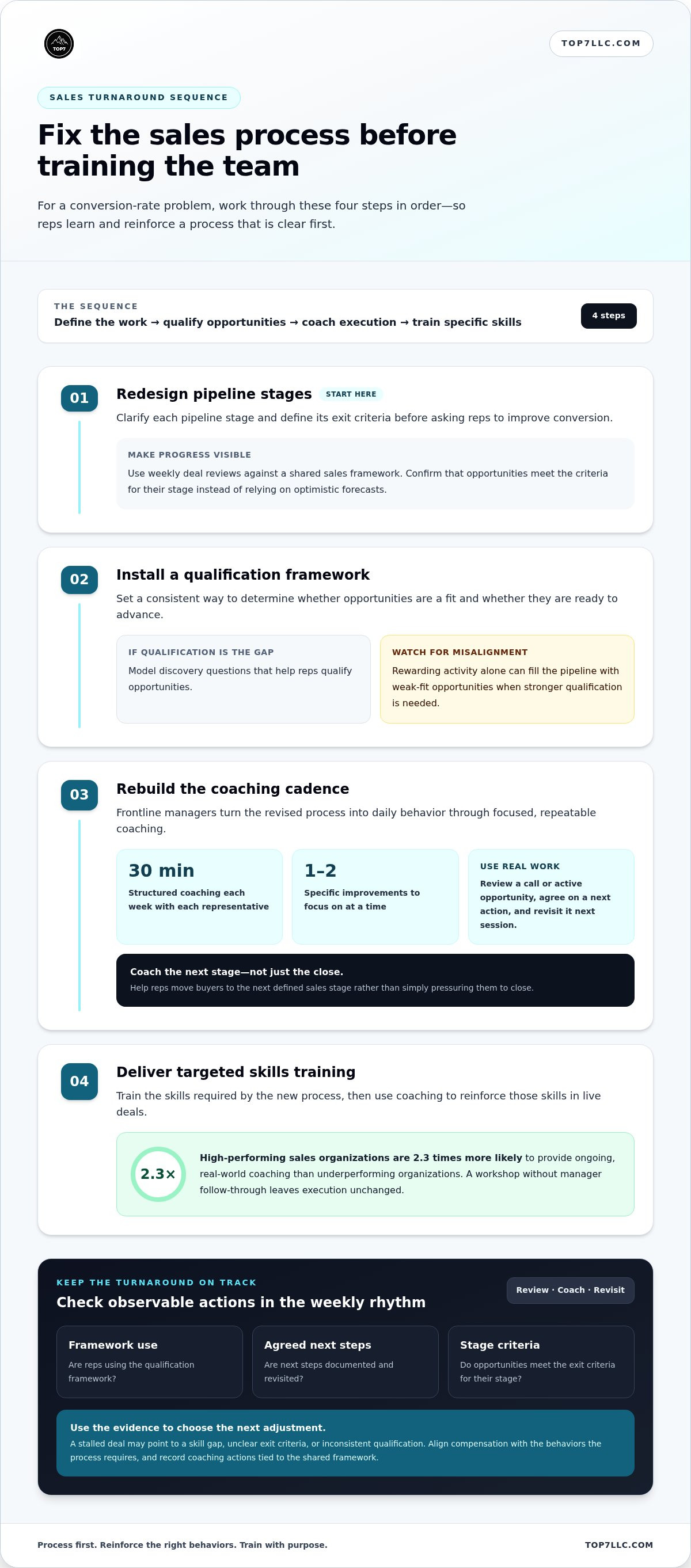
For a conversion-rate problem, start by redesigning pipeline stages and defining exit criteria. Then install a qualification framework, rebuild the coaching cadence, and deliver targeted skills training. Reversing this order risks training reps to work within a broken process. Use weekly deal reviews against a shared sales framework to confirm that opportunities meet each stage’s criteria, rather than relying on optimistic forecasts.
Manager Coaching and Accountability
Frontline managers must turn the revised sales process into daily behavior. Schedule 30 minutes weekly for structured coaching with each representative, and focus on 1-2 specific improvements at a time. Review a real call or active opportunity, agree on a next action, then revisit it in the following session. Coach reps to advance buyers to the next sales stage, not just pressure them to close.
Training and Coaching Alignment
Enablement should teach the skills the new process requires, while coaching reinforces those skills in live deals. If qualification is the gap, training can model discovery questions; managers can then review their use in calls and deal reviews. High-performing sales organizations are 2.3 times more likely to provide ongoing, real-world coaching than underperforming organizations. A workshop without manager follow-through leaves execution unchanged.
Make accountability visible in the weekly operating rhythm. Each manager should bring a focused set of opportunities to review, identify where deals stall, and record a coaching action tied to the shared framework. Leaders can then distinguish a skill gap from unclear exit criteria or inconsistent qualification. That distinction points to the right next step: coaching, process correction, or training.
Compensation should reinforce the behaviors the sales process requires. If the team needs stronger qualification, rewarding activity alone can encourage reps to fill the pipeline with weak-fit opportunities. Align incentive measures with the desired outcome, then check whether they support disciplined progress through the stages. Managers should flag any conflict between compensation and process during weekly deal reviews.
Measure adoption through observable actions: whether reps use the qualification framework, document agreed next steps, and meet stage exit criteria. Managers should coach from these examples, not vague judgments about effort. This links process design to skills practice and accountability, helping leaders pinpoint which part of the turnaround needs adjustment.
For a conversion-rate problem, the recommended sequence is to redesign pipeline stages and exit criteria, install a qualification framework, rebuild the coaching cadence, and then deliver skills training. Keeping these steps in order clarifies what progress means before reinforcing the behaviors that move opportunities forward.
Wesleyne Whittaker says she coaches sales managers when working with an organization. Their coaching should help representatives advance buyers to the next sales stage, rather than focus only on closing the deal. Each conversation should connect to the process’s next defined step.
Assessment of sales calls, people, processes, and systems
A useful assessment connects evidence from sales calls to pipeline movement and revenue outcomes. It identifies where execution breaks down and defines changes leaders can put into practice.
Choose a sales restructuring consultant who can assess recorded calls, pipeline data, team capabilities, management routines, and systems, then turn the findings into an executable plan. Ask for clear diagnostic steps and decision criteria, not a generic training recommendation.
A turnaround consultant diagnoses the sales system and recommends changes; a fractional sales leader takes an ongoing role in leadership and execution. The right fit depends on whether you need a focused assessment or continuing management capacity.
In the United States, consulting cost depends on the engagement scope, team complexity, and implementation support. The price depends on the case and is given after a quote request, with the assessment depth and execution responsibilities shaping the scope.
Hourly models bill time, project models define work around agreed deliverables, and retainers cover ongoing advisory support. Compare the work included, access to leadership, and responsibility for implementation, rather than choosing by billing label alone.
Sales consulting firms in the United States vary by specialization and delivery model. Evaluate how each engagement assesses calls, people, processes, and systems, and whether its recommendations address your specific sales motion.
Assessing Calls, People, and Systems
Start with evidence from calls, CRM records, pipeline stages, and manager interviews. Analyze the last 20 lost deals to identify whether demand or sales availability is the constraint; spend 30 minutes this week tracing the pattern. Compare call behavior with stage definitions, follow-up practices, and system records.
Assess skills against the sales cycle, not a generic competency checklist. Enterprise selling, for example, may require stakeholder mapping and multi-threaded follow-up, while a shorter sales motion may depend on timely qualification. Connect each observed gap to a specific process or capability.
Separating Process Problems from Skills Gaps
A process problem tends to appear across multiple representatives: unclear ownership, inconsistent stage criteria, or delayed lead routing. The average B2B sales team takes 42 hours to respond to a new lead, so inspect routing and response workflows before blaming individual effort.
A skills gap exists when the process is clear but a representative struggles with a defined step, such as discovery or objection handling. Check whether CRM fields support the required workflow, and change the process or technology only when evidence shows the current system is blocking execution.
Use stage conversion, pipeline coverage, deal velocity, and quota attainment distribution to connect diagnosis with revenue impact. An advisory engagement can turn these findings into a prioritized implementation plan, with owners and review points for each change.
What Really Drives Sales Performance?
Actual performance reflects more than individual effort. Sales leaders need structured metrics connecting goals, territory opportunity, manager accountability, and customer-facing activity.
Compensation and Performance Management
Compensation should reward behavior that supports profitable, durable sales, not just booked volume. For example, if customer churn becomes a concern around two years, leaders can examine whether contract-length incentives support retention. One example uses a 5% bonus for contracts lasting three or more years. The measure matters: incentives tied only to bookings can reward deals that fail to deliver lasting value.
Pair compensation with a daily scorecard tracking 3-4 leading indicators for each representative. Managers can review those measures alongside actual outcomes, then investigate mismatches. Strong activity with weak conversion may point to poor-fit prospects or deal execution. Weak activity calls for a different management response. Make the accountability clear: each metric needs an owner and a follow-up action.
Assessing Representatives and Managers
Assess representatives through results and behaviors, not quota attainment alone. Top-performing representatives spend 35% more time on customer-facing activities than underperforming peers. Compare call time, opportunity progression, and follow-up quality to see whether each person uses available selling time effectively.
Managers need the same evidence-based review. A team with only 40% of members attaining quota may have problems beyond individual effort, including coaching, territory design, or sales strategy. Ask each manager to explain the gap between expected and actual performance, then connect that explanation to pipeline evidence and specific coaching actions.
Territory and Quota Management
Quota pressure can mislead when territory potential varies. Compare opportunity quality, customer access, and pipeline coverage before judging individual results. A quota should reflect realistic selling conditions and the sales cycle, not simply last year’s target plus an arbitrary increase.
The top 20% of sales representatives typically drive around 80% of revenue. That concentration makes territory balance and knowledge sharing essential. Review where high performers find opportunities, then distinguish repeatable practices from territory advantages. President’s Club eligibility can be set for 5-20% of the team, depending on how exclusive the recognition should be.
Management by Objectives, popularized by Peter Drucker’s 1954 book The Practice of Management, links goals to measurable responsibilities. Apply that discipline by setting a clear outcome, assigning an accountable owner, and reviewing progress against leading indicators. Over 50% of sales representatives expect to miss quota this year, while a cited research figure says 67% do not expect to meet quota. Those signals call for sharper goals and diagnosis, not pressure alone.
Turn each objective into a structured review: compare target with actual results, identify the main variance, and agree on a corrective action. If a representative has a strong pipeline but deals stall, inspect stage progression. If opportunity creation is weak, examine territory access and prospecting priorities. This keeps performance management focused on causes, not blame.
Performance reviews and termination considerations
Use a consistent framework to distinguish recoverable performance gaps from role or system mismatches. Track the same baseline before and after changes, then make staffing decisions based on evidence, not frustration.
Baselines and Performance Tracking
Before restructuring, record four baseline measures: stage conversion rates, pipeline coverage, average deal velocity, and quota attainment distribution. Together, they show where opportunities stall and whether results depend on a small group of sellers. Keep definitions consistent across the sales organization. Review turnaround metrics at 60-day intervals after implementation, so leaders can distinguish real improvement from ordinary deal timing.
Set a starting point for each metric and assign an owner to update it. For example, compare stage conversion by team and representative, then check whether changes followed a process adjustment or coaching intervention. The framework works only when each reporting period uses comparable data, definitions, and rules. Otherwise, organizations may mistake changes in measurement for sales success.
KPIs and Team Metrics
Use leading and outcome measures together. Stage conversion, pipeline coverage, deal velocity, and quota attainment distribution provide a practical core; call quality and follow-up completion can help explain changes in those results. No single KPI proves a representative is failing. Compare individual performance with team patterns and territory conditions before choosing an intervention.
When performance first begins to drift, apply a structured improvement plan. Set 30-, 60-, and 90-day milestones with observable actions, coaching support, and a review date. A representative might need to improve discovery quality before conversion results can reasonably change. Track both the agreed behavior and its sales outcome; a quota figure alone cannot show whether the plan is working.
Restructuring and Replacement Risks
Replacing an underperforming employee costs over 200% of that employee’s annual salary. Restructuring also risks disrupting customer relationships, removing institutional knowledge, and leaving territory coverage thin. Before termination, identify whether the gap is individual, managerial, or process-wide. A shared shortfall across the team points toward a broader sales organization problem, not an automatic case for replacing every representative.
Use improvement milestones to make the decision specific. Document the expected behavior, support provided, evidence reviewed, and progress at each checkpoint. If a representative misses agreed milestones despite clear expectations and coaching, leaders have a stronger basis for a role decision. If several sellers miss the same target, examine the sales process and management conditions before making personnel changes.
Performance reviews should connect evidence to action. At each 60-day review after implementation, compare the baseline with current results, check milestone completion, and decide whether to continue coaching, adjust the plan, or change team structure. That sequence gives the sales organization a defensible path to improvement while limiting decisions driven by one difficult quarter.
Case study results from restructuring an enterprise sales team
One reported enterprise sales case shows why restructuring must begin with analysis, not assumptions. The assessment covered 30 representatives and 3 managers, then linked capability, pipeline, and sales results to the changes made. Its takeaway: rebuild around the actual sales cycle, not a generic playbook.
Nearly 40% of the assessed representatives lacked core capabilities for the company’s complex enterprise sales cycle. That finding pointed to a specific mismatch between the team’s skills and the demands of its buyers. A broad training course alone wouldn’t fix the problem. The analysis had to identify which roles and capabilities fit the sales motion.
In the restructuring, 10 representatives identified as a poor fit for enterprise sales were helped to transition out. The team then hired 8 new representatives. Those staffing decisions followed the assessment rather than serving as its starting point. That distinction matters: replacing people without defining the required capabilities risks recreating the same gaps.
Within 12 months, the restructured team’s average deal size increased by 30%, while its sales cycle shortened by 20%. The team also exceeded its annual revenue target by 15% within 12 months. These results show what the reported case achieved; they aren’t a universal benchmark. The important point is that performance was evaluated across deal value, cycle time, and revenue targets, rather than one headline metric.
A separate reported result describes a sales conversion rate rising from 19% to 35%. Read that alongside the enterprise case, not as proof that every restructuring will produce the same change. Conversion, deal size, cycle length, and quota attainment measure different points in the sales system. A strong review connects each movement to the pipeline stages and selling behaviors being changed.
How long does a sales team turnaround typically take? The reported enterprise case measured results within 12 months, while turnaround timing depends on the sales cycle and how quickly the organization implements changes. Review early execution separately from lagging revenue results; complex enterprise deals take time to progress.
To assess a case study, look beyond the final percentage. Check the team’s starting conditions, assessment findings, staffing changes, sales methodology, and measurement window. Then ask whether the new playbook changed how representatives qualify and advance opportunities. Without that chain of evidence, a before-and-after figure says little about why performance changed.
Use this case as a test for your own turnaround plan: define the capability gap, connect interventions to pipeline behavior, and track multiple outcomes. Discuss an evidence-led sales turnaround when your team needs a structured path from diagnosis to execution.
Relying on surface-level comparisons alone can mislead executives. Wesleyne Whittaker notes that CEOs she has spoken with often invested in new tools, promoted top representatives, and brought in outside training, yet sales results remained unpredictable. Industry observations estimate a 70-80% risk of failure for hope-driven restructuring approaches that lack a solid diagnostic foundation.
Top7: Fractional CTO
Top7 provides Fractional CTO support when sales performance depends on better alignment between technology, systems, and execution. If the assessment points to broader operating issues, a Fractional COO can help coordinate processes and accountability, while a Fractional CEO can support leadership priorities across the organization.
Turn to Top7 when the diagnosis is clear but your team needs senior leadership capacity to move the agreed changes forward. A Fractional CTO is relevant when sales tools or technology decisions are part of the bottleneck; a Fractional COO may fit when execution and operating workflows need stronger coordination. The right leadership focus depends on what is obstructing progress.
Visit top7llc.com to discuss the leadership support that fits your organization’s needs.
Turn the Turnaround Plan Into Operating Discipline
A sales reset matters only when new decisions hold up under the pressure of daily execution. Assign clear owners, establish review routines, and ensure leaders can act on what the numbers reveal. Without that operating discipline, even a strong plan can become another document that changes nothing.
A consultant for rebuilding an underperforming sales team can help leadership connect strategic choices with execution. Decide where your organization needs stronger ownership: sales technology, operating workflows, or company-wide direction. Match leadership support to the constraint, not to a fashionable title.
Top7 offers Fractional CTO, Fractional COO, and Fractional CEO support for organizations that need senior leadership capacity to move priorities forward. Choose the focus that fits the work ahead, then turn the plan into consistent action.
Contact Top7 about rebuilding your sales team and take the next step with clarity.
Frequently Asked Questions
What does a sales team turnaround consultant do?
A consultant for rebuilding an underperforming sales team diagnoses why revenue execution is falling short, then helps leaders prioritize corrective action. The work may include reviewing deal evidence, clarifying roles, testing whether targets fit the sales motion, and building an implementation roadmap. For example, if qualified opportunities stall after discovery, trace handoffs and decision criteria before recommending coaching or process changes.
What is the process for rebuilding an underperforming sales team?
Start by agreeing on the business problem and who owns the turnaround decision. Gather evidence, define the roles and capabilities the sales motion requires, then sequence operational changes so teams are not asked to follow conflicting rules. Test the revised approach with a defined group or workflow, capture feedback from managers and reps, and refine the operating plan before expanding it across the organization.



Comments